Analysis
A Story of Aspiration: Western Mobilisation to African Jihadist Groups, 2019–2026
31 Aug 2026
The case of six French teenagers who dubbed themselves Team Musul in an online group chat initially reads like a familiar file in a country that continues to see Islamic State-inspired plots and occasional travel attempts to the Levant. However, this group had set its sights on Africa. Five of them showed sustained and credible interest in joining Islamic State Mozambique Province, discussing flights, routes to the group once there, and, ultimately, dying as martyrs. This seemingly peripheral affiliate is much diminished from its 2021 apex, when its estimated 2,000 fighters waged a campaign of exceptional cruelty. Nonetheless, its activity has recently increased, its revenue portfolio expanded, and its propaganda polished, epitomised by the Noor al-Jihad video released in August 2025. Law enforcement arrested the teenagers before they ever set foot in Mozambique.
Measured by terrorism-related deaths, the centre of terrorist activity has shifted from the Middle East to Sub-Saharan Africa. Foreign terrorist fighters (FTFs) from Europe and North America, however, have not descended upon the region as they did on the Levant after the establishment of the caliphate. FTF flows remain largely intra-African, with documented travel by Islamic State technical specialists from the Middle East training African affiliates on capabilities from drones to AI.
Nonetheless, recent cases from Europe and the United States point to some appetite for joining Islamic State’s African affiliates. Most recently, the “frustrated foreign fighters” phenomenon has reared its head again in Europe – this time with an Africa nexus. The perpetrator of the July 2026 Berlin Pride attack, which killed one person and injured 29, had been halted fourteen months earlier at Nouakchott airport as he attempted to join IS-Sahel, later attempting to join IS in Syria. Drawing on a dataset of Western aspirants to African jihadist groups compiled by the author, this analysis documents these cases and assesses the factors that make this a latent threat.
Dataset
The dataset documents attempted and successful travel to Islamic State- or al-Qaeda-affiliated groups in Sub-Saharan Africa, including behavioural indicators (e.g., tickets, stated destinations, and recruiter contacts). Only citizens and residents, legal or illegal, of Europe and North America are included. The dataset covers January 2019 to August 2026, the post-territorial-caliphate period. It reflects only publicly known cases and should be treated as a starting point for inquiry. Assertions without substantial evidence were not logged. Aggregate reporting hints at additional cases that could not be individually identified through open sources. Additionally, some Western countries with large diasporas reported no cases, possibly reflecting a lack of reporting rather than a lack of cases. Aspirants almost exclusively became visible through interception en route or through the disruption of a domestic plot. It is therefore reasonable to expect that there have been more travel attempts than those captured in this dataset.
The Record
Between January 2019 and August 2026, open sources documented 25 cases involving 36 individuals from Europe or the United States who travelled, attempted to travel, or expressed interest in travelling to join terrorist groups in Sub-Saharan Africa. The discrepancy stems from four cases of ‘cells’ that attempted to travel together. Travel pairs were logged as separate cases when one individual later acted independently.
Fifteen attempted travel cases were recorded, four of which involved multiple attempts. For example, a Swede attempted to reach IS-Somalia three times, twice with the same travel companion and once by himself. He also helped people acquire Ethiopian visas, suggesting more potential cases. A Dutch national who attempted to reach IS-Somalia in 2023 again expressed interest in travel to Somalia, Mozambique, or Syria in 2024, after his passport was already seized. In messages to a 16-year-old Belgian boy, he claimed to know two “brothers” soon travelling to Islamic State in Africa, not specifying the affiliate and suggested that he join.
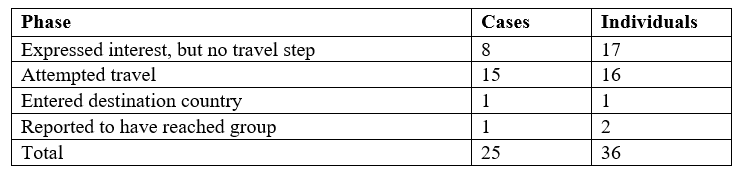
Two cases ended with the traveller reaching the destination country, with only one case identified where the group was effectively joined. In eight cases, intent to travel was present, but no concrete operational steps had been taken – typically discovered during an investigation into domestic attack planning.
Tallying all travel attempts, including repeat tries, shows eight in 2023, twelve in 2024, and two in 2025. The apparent decline after 2024 may reflect a lag rather than an absence of cases, as legal proceedings often yielded the data points of this dataset. For example, an Italian national residing in the UK, stopped at Manchester Airport in November 2024 en route to IS-Somalia, was not reported on until 2025, with his sentencing in 2026 providing more detail.
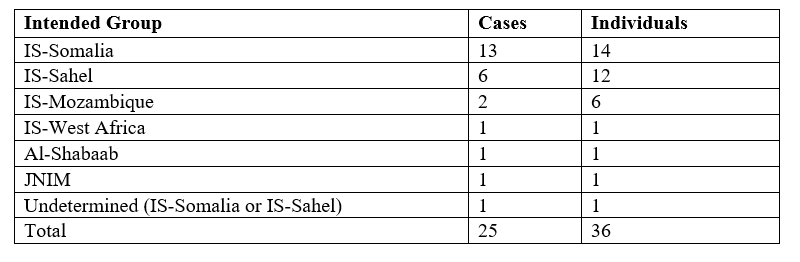
Somalia was the most recurring destination: thirteen cases involved aspirants for IS-Somalia and one for al-Shabaab. Seven cases indicated an intent to mobilise to the Sahel – six to IS-Sahel and one to Jama’at Nusrat al-Islam wal-Muslimin (JNIM) – and two to Mozambique.
IS-West Africa appears twice but is logged once: one case was an artefact of a law enforcement operation in which an undercover FBI agent posing as an Islamic State recruiter assigned an American convert, who had repeatedly stated his desire to join IS-Sahel, to a fictional unit of IS-West Africa, which he accepted. The other case featured an Austrian 18-year-old boy who searched for how to join IS-West Africa, but appeared further along in planning a domestic attack than in his travel plans.
Somalia and the Sahel
Cases of intended mobilisation to Somalia differ qualitatively from those to the Sahel and other African theatres. Almost all individuals who had started to physically move towards their chosen group were headed to Somalia, while non-Somalia-bound cases often remained immature and aspirational.
Eight of the fourteen Somalia-bound cases had already left their country of residence when they were stopped or failed to reach the group once on the ground – including arrests and stops in Ethiopia, Kenya, France, Türkiye, and Somalia. Three more were detained at the departure gate. The remaining three were disrupted late in the process by family intervention. Most were seeking to fly into Ethiopia and then cross by land into Somalia.
Two cases featured aspirants reaching Somalia. In the first case, two Berlin residents – a German and a Russian – are reported to have reached Somalia to fight, according to a German terrorism expert. However, the second case involves a Somali national in the UK who travelled to Somalia in January 2025, spent five weeks in the country regularly speaking with alleged Islamic State recruiters. He returned to the UK after they explained that the roads were closed because of the war and airstrikes, and thus failing to reach IS-controlled territory. The man was only arrested in January 2026, a year after his journey to Somalia.
In contrast, aspirants bound for IS-Sahel, IS-West Africa, and IS-Mozambique were more often discovered when law enforcement retrieved digital evidence of their travel aspirations, typically while investigating a domestic attack plot. Seven of ten cases with a destination other than Somalia surfaced this way. An Algerian national in France said he was ready to wage armed jihad and join IS-Sahel; a Tunisian in France expressed interest in IS-Mozambique or Syria. Both were arrested planning domestic plots, with no concrete travel plans reported publicly.
However, other Sahel-bound travel cases were more mature. Two Moroccan nationals in Spain, part of a transnational cell with a member in Morocco, set aside savings and considered overland routes to Mali. The American convert mentioned earlier had a flight to Rabat booked. The Berlin 2026 attacker made it to Nouakchott before being stopped.
Yet these Western aspirants reveal only part of the interest in the Sahel route. Moroccan authorities have dismantled more than forty Sahel and Sub-Saharan African-linked cells, and security officials have named the Sahel and Somalia as increasingly common destinations for aspirants. The North African leg of the Sahel-bound corridor is thus far more established than this Western-focused dataset suggests.
Overarchingly, the cases logged demonstrate considerable intent–with some cases featuring multiple travel attempts–but little confirmed success in actually mobilising to African jihadist groups.
Domestic Plots
The dataset had a notable domestic plot axis. Mature domestic plots appeared most often where travel plans had not progressed: all eight cases lacking concrete travel arrangements had some domestic plot dimension.
The sequence of travel and domestic plots varied across the dataset. A Maryland aspirant told an undercover officer he would attack Jewish targets domestically if his travel to Somalia failed. A cell arrested in Spain, including former Spanish Guantanamo detainee Hamed Abderrahman Ahmed, was planning attacks and then seeking to join the ranks of IS-Sahel – a sort of surreal escape route. In the UK, a teenager abandoned a well-advanced domestic attack plan after an Islamic State contact online convinced him to travel to Somalia. The Berlin attacker completed the frustrated traveller arc when he drove into a Pride crowd in July 2026 after his failed attempt to join IS-Sahel – the only completed attack in the dataset.
Fitting the wider terrorist threat landscape, Jewish targets were most frequently discussed by aspirant FTFs. The 7 October Hamas attacks also feature in the dataset: the American who moved to Cairo cited the attacks as his reason for wanting to fight, settling on al-Shabaab in Somalia. As with Western FTFs to the Levant a decade ago, a crime-terror nexus was present. Eight cases featured aspirants with known criminal pasts reported in open sources, including burglary, homicide,drug-related crime, aggravated robbery, and gang ties.
Understanding the Pull
Reflecting on the phenomenon of FTFs in Africa, terrorism expert Austin Doctor astutely observed that “foreign fighters don’t move toward a vacuum; they are drawn to momentum.” This was best embodied by the American convert who, weighing his travel plans, stated that “the strength is more in Africa.” In this dataset, the momentum that attracts Western aspirants appears primarily stature- and prominence-related.
The earliest and most explicit call for hijra to the African affiliates came in March 2015, when then spokesperson Abu Muhammed al-Adnani, accepting Boko Haram’s pledge, called on foreign fighters to join IS-West Africa – heeded primarily by African fighters. In February 2026, Islamic State’s al-Furqan issued an address by spokesperson Abu Hudhayfa al-Ansari calling on Muslim youth to migrate to its branches. As Islamic State expert Aaron Zelin notes, the address calls implicitly for mobilisation to the African provinces, touted as having fought important battles spearheaded by foreign fighters. According to Zelin, the Africa focus reads as something of a reprimand for the group’s Middle Eastern supporters: “The same messaging berates Arab audiences for choosing an easy life over jihad, effectively conceding that the movement’s historic recruiting heartland has gone quiet while insisting the caravan has simply moved south.”
Calls for hijra also come from outside official outlets. Research by the Institute for Strategic Dialogue’s Moustafa Ayad found that in 2024, supporter page content on Africa outpaced that on the Levant significantly. One page, for example, promoted hijra to Somalia and Mozambique, the latter destination pitched alongside pictures of balmy white beaches and sunsets. Interestingly, the Team Musul teenagers mentioned earlier expressed interest in IS-Mozambique a year before the official IS Noor al-Jihad video put it decidedly on the international propaganda map, suggesting potential interaction with the supporter ecosystem.
Doctor also points to “subregional details — e.g., distance, presence of existing routes, levels of border security, etc. — that directly affect the feasibility of travel.” The dataset illustrates this vividly. Somalia-bound aspirants almost all converged on a single route: Ethiopian e-visas bought online, flights to Addis Ababa, then an attempted overland crossing into Somalia. No comparable formulaic path appears in the other cases, including those bound for the Sahel. One pair hesitated between driving down to Mali or flying into Senegal and then crossing. Another wanted to go through Morocco, and one case was through Mauritania. Questions about the logistics of making hijra to African provinces recur across Islamic State’s digital ecosystem, including in the comment section of supporter pages.
During the mid-2010s wave of FTFs to the Levant, aspirants could consult manuals on travel advice and how to avoid suspicion en route. No similar content was identified, but Moroccan authorities have found something resembling a playbook for aspirant travellers: when a cell was dismantled in October 2023, they found a manuscript that included methods for joining IS-Sahel. Whether it circulated among the Western cases is unclear, as they all took different steps.
Western aspirants and their recruiters echoed the importance of logistical feasibility in some cases. The Dutch national arrested in France had been told on Telegram that reaching Iraq would be difficult and that Somalia was more feasible. The UK traveller who reached Somalia could not reach the group because recruiters told him the roads were closed due to airstrikes. In June 2026, a media group linked to IS-West Africa noted in a statement that routes were closed following airstrikes, effectively admitting that aspirants should not try to reach them–a strong departure from al-Adnani’s 2015 speech.
Next to logistical hurdles, the destination can also be imposed on aspirants rather than carefully decided. Islamic State recruiters allegedly selected Somalia for the Swiss national and organised his travel for him, and a fighter in Somalia arranged the Ethiopian e-visa and flight itinerary for the Maryland aspirant.
The dataset, even in its incompleteness, suggests that a province’s outward-facing prominence may seduce Western aspirants rather than operational tempo. IS-West Africa and IS-Central Africa dominate the continent in attack claims, but they show little to no presence in the aspirant FTF dataset. Claims do not equate to lethality, but the discrepancy is nonetheless stark: aspirants do not appear to neatly follow Islamic State’s own attack claims. Instead, a different measure of prominence appears to matter, related to standing in Islamic State’s overall organisation and visibility in the West. IS-Somalia hosts the al-Karrar office, a hub for finance, logistics, and training on the continent and beyond, and its head, Abdulqadir Mumin, appears by name and image in Western media.
Islamic State’s territorial insurgency in the Sahel is starting to enjoy a similar global image of organisational prominence. With cross-national plots, the group is effectively cementing itself as a transnational threat that reaches into Europe, as flagged by terrorism expert Lucas Webber. Larger future mobilisation from the West should not be dismissed. The “resurgence of violent rivalry” with JNIM in 2026 may attract FTFs drawn to inter-militant competition, and Western counter-terrorism pressure may spark further mobilisation. While the Trump Administration’s latest plans for Mali appear to be an intervention aimed at countering JNIM, the US has already struck IS-Sahel-linked Lakurawa in Nigeria, a sign of its prominence in global threat assessments.
Outlook
Publicly identifiable cases of individuals in Europe and North America planning to join African terrorist groups indicate persistent interest but limited success, making this, as of 2026, primarily a story of aspiration. Europol’s reports confirm this trend. The 2025 TE-SAT edition, noted that outbound terrorist travel remained at a low level, but Africa, “especially Somalia,” remained discussed in radicalised circles. The 2026 report records 24 arrests in the EU for travel for terrorist purposes, most still concerning people trying to reach Syria. Nonetheless, that same report flags that, with Africa as a hotspot for terrorist activity, “there remained key concerns about its attraction for FTFs and the possibility of external operations against the EU.”
This article represents the views of the author(s) solely. ICCT is an independent foundation, and takes no institutional positions on matters of policy unless clearly stated otherwise.
Photo credit: James Wiseman on Unsplash